Bristol is currently at the heart of a domestic energy transformation. From the colourful terraced houses of Totterdown to the Victorian mansions of Clifton, houseowners are increasingly abandoning the use of the traditionally installed gas boilers and opting for eco-friendly alternatives. Among these alternatives, the Air Source Heat Pump (ASHP) system stands as the most prominent in leading the change.
But many early adopters have discovered that simply swapping a boiler for a heat pump is only half the battle. To truly unlock the efficiency of low-carbon heating, the fabric of the floor itself must change.
This is where the importance of the “thermal envelope” comes in. In order for a heat pump to have the highest coefficient of performance, it has to transport the heat via a highly conductive medium. This is precisely the function that thermal screed in Bristol has come to play in effective retrofitting. This is the key link connecting the renewable energy source with the internal space, ensuring that each unit of energy extracted from the air is transferred inside.
The Low-Temperature Challenge
In order to appreciate the need for specialist screed, there first has to be an understanding of the differences between heat pumps and gas boilers.
A “high-temperature” boiler will typically involve the pumping of water through radiators at around 70°C to 80°C, whereas the Air Source Heat Pump will work on a “low-temperature” basis, requiring optimum functioning at 35°C to 45°C.
Since the water in the underfloor heating pipes will be considerably cooler in comparison to traditional systems, it will not be feasible for the flooring material to be an insulator. Traditional sand and cement screeds may be effective for several decades without any problems; however, they are rather porous, containing minute air pockets.
Air is not a very efficient conductor of heat. Having to transfer their heat through a pore-ridden layer of traditional screed would cause an electrical heat pump system to suffer increased running times and rising electricity costs, thus reducing any environmental credentials it may have.
Conductivity: The Science of Thermal Screed
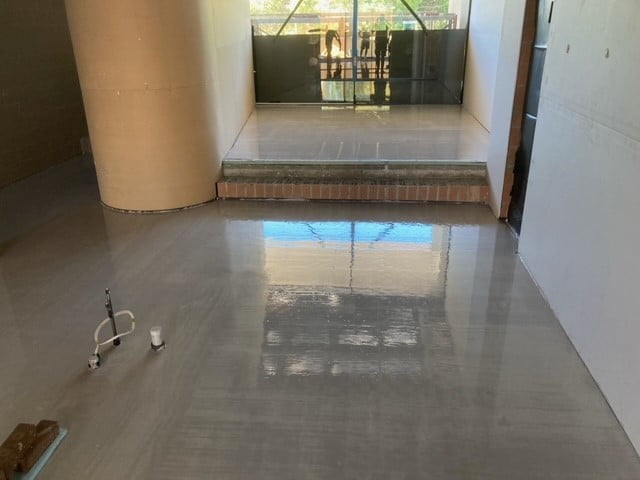
Thermal screeds are designed with the specific aim of removing the ‘thermal lag’ that exists in normal flooring. These screeds are liquid-based materials that are “ultra-conductive.” Their special formula allows them to have a thermal conductivity that can range double that of the normal mix.
When pouring a liquid screed, it acts like a fluid and completely envelopes the underfloor heating pipes. This has huge implications. On a hand-laid sand and cement floor, there could be “minute voids” or spaces where the screed doesn’t completely contact the heating pipe. These are thermal break points. On a liquid screed system, there’s 100% “pipe to screed contact.”
As soon as the heat pump turns on to circulate hot water, it’s instantly drawn into the screed and radiated back up into the room.
Efficiency in Practice: Urban Landscape of Bristol
It is observed that Bristol possesses a highly diverse housing stock, and it is a fact that every type of housing faces different difficulties regarding the integration of heat pumps.
- Period Properties: In Victorian and Georgian refurbs, ceiling heights and floor levels may be established. Thermal screeds are often laid much shallower than conventional screeds, sometimes just 20mm to 30mm thick to cover the pipework. In this way, valuable head height is maintained while maximising warmth.
- Modern Extensions, Kitchen-Diner Extensions: Here, a smooth transition between indoors and outdoors is often a priority. This accuracy also ensures a level finish, which is vital if large-format tiles, adept at retaining and spreading warmth, are to work to full effect.
- The “Smart Home” Link: Today, people in Bristol might employ a “smart home” device such as Nest/Tado in their home to control temperatures. Additionally, a screed floor reacts quicker to a smart home device than a conventional one. Suppose the sunshine appears in a room due to extensive windows. A thermally insulated floor will cool more quickly than a conventional floor to eliminate “overheating.”
While the focus is often on local city projects, the trend for high-spec efficiency is mirrored across the region. For instance, the demand for high-performance liquid screed in Oxfordshire has seen a similar spike, particularly in rural barn conversions where heat pumps are the only viable alternative to expensive oil heating.
Speed of Installation and Drying
A significant barrier when undertaking home renovations is the downtime. Traditional screeds will take weeks to dry and then months before any final floor finish can be applied to the screed.
Therefore, the speed of the liquid thermal screed is one of its major advantages, particularly where quick project completion is required in urban cities such as Bristol. Here are the benefits you can leverage:
- Fast Application: With this technique, vast regions can be covered in a matter of hours as opposed to days through manual application via the wheelbarrow.
- Early Foot Traffic: Most liquid thermal screeds are ready for foot traffic after only 24 to 48 hours. This means that other trades, such as electricians, plumbers, and decorators, can quickly return to the site.
- Force Drying: Thermal screeds are also eligible for force drying, which involves using the heating system in the house to dry the screeds in just seven days, reducing waiting time before tiling or wood floor installation.
Protecting the Investment: The DPM and Preparation
A good retrofit is not only about the pour; it is about preparation. Prior to the installation of the thermal screed, the sub-base layer is to be perfected. This includes quality floor insulation in the shape of PIR boards, coupled with a sound DPM.
When it comes to older areas that are prone to damp, proper tanking of the subfloor is a priority. When the moisture reaches the screed, it could impact its thermal efficiency, making it vulnerable to floor finish failure. The expansion strips around the floor should also provide a functioning expansion movement as it expands and shrinks during changes in temperature, a phenomenon that, if not catered to, leads to unwanted cracks.
Summary of Benefits for the Homeowner
If you are thinking of making the switch to renewable heating, the choice of screed could be every bit as crucial a consideration as the selection of the heat pump. In choosing a thermal screed in Bristol, it guarantees the following:
- Lower Operating Expenditures: Your heat pump will work less to provide the same room temperature.
- Best Comfort: No “cold spots” on the floor anymore, and the warmth is spread completely evenly.
- Long-Term Reliability: Improved piping encapsulation helps protect the UFH system against any sort of damage and corrosion.
- Environmental Impact: The maximisation of efficiency in an ASHP remains the best approach in ensuring that carbon emissions in a household align with the UK’s Net Zero targets in the year 2050.
Conclusion
Bristol is at the forefront of making cities more sustainable, but the “Retrofit Revolution” is only just underway. As Bristol looks to a gasless future, it is the technology in our homes, the bit we can’t see lurking beneath our floorboards, that will be critical to making our lives more comfortable and affordable.
Thermal screed is no longer an indulgence; it’s an essential part of the efficient house of the future in Britain.