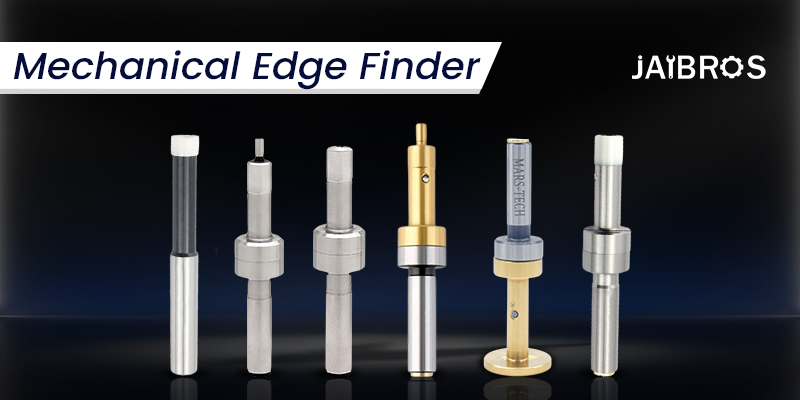
Achieving Faster CNC Setup and Precision Using Edge Finder
In CNC machining, speed and accuracy are closely connected. Faster production is only valuable when parts meet dimensional requirements and quality standards. One of the most critical steps that influences both factors is machine setup, especially the process of locating the exact reference point of a workpiece before machining begins.
Accurate edge detection helps machinists define the correct origin, ensuring that tool paths follow the programmed design precisely. This is where an edge finder plays a vital role. It enables faster setup, improves repeatability, and reduces the risk of costly errors, making it an essential tool in CNC machining environments.
Why Accurate Setup Matters in CNC Machining
Every CNC operation starts with defining the workpiece zero point. If this reference is incorrect, even the most advanced CNC program will produce inaccurate results. Poor setup can lead to:
- Dimensional inaccuracies
- Increased scrap and rework
- Tool breakage
- Longer production cycles
Using precise edge detection methods allows machinists to eliminate guesswork and rely on measurable, repeatable positioning.
How Edge Detection Speeds Up CNC Setup
Traditional methods like trial cuts, paper methods, or visual estimation take time and often lack consistency. Modern edge detection tools simplify and accelerate the setup process.
An edge finder tool allows machinists to quickly locate the exact boundary of a workpiece. Instead of making multiple test movements, operators can establish reference points in a single, controlled motion. This significantly reduces setup time, especially in shops handling frequent job changes or short production runs.
Faster setup also means reduced machine downtime, allowing CNC machines to spend more time cutting and less time waiting.
Improving Machining Accuracy Through Precise Referencing
Accuracy in CNC machining depends heavily on how precisely the workpiece is aligned with the machine coordinate system. Even a small offset error can result in out-of-tolerance parts. By using an edge finder , machinists can consistently establish accurate reference points. This improves:
- Dimensional accuracy
- Repeatability across batches
- Confidence in complex machining operations
Accurate referencing also reduces vibration and uneven tool engagement, contributing to better surface finishes and longer tool life.
Mechanical vs Electronic Edge Detection in CNC Machining
Different CNC environments require different levels of precision and speed. This has led to the use of both mechanical and electronic solutions.
Mechanical Edge Finder
A mechanical edge finder relies on physical contact and visual indication to detect the workpiece edge. It is widely used because it is:
- Simple to operate
- Cost-effective
- Reliable for general CNC milling tasks
Mechanical versions are ideal for standard machining operations and workshops that value durability and ease of use.
Electronic Edge Finder
An electronic edge finder uses electrical contact or sensors to detect edges with higher sensitivity. It offers:
- Faster edge detection
- Reduced operator dependency
- Higher accuracy for precision work
Electronic models are especially useful in high-precision CNC machining, where tight tolerances and speed are critical.
Supporting High-Precision CNC Operations
Industries such as aerospace, automotive, and medical manufacturing require extremely high levels of accuracy. Components often have complex geometries and strict tolerance limits.
In such environments, an edge finder helps ensure that every machining cycle starts from a precise and verified reference point. This consistency supports quality compliance, reduces inspection failures, and improves overall process reliability.
Role in Prototype and Small-Batch Production
Prototyping and small-batch production demand flexibility and quick turnaround times. Advanced probing systems may not always be practical or cost-effective for such applications.
An edge finder provides a simple and efficient solution for quick setups without complex programming. This makes it ideal for job shops, R&D departments, and manufacturers handling custom or low-volume projects.
Enhancing Repeatability in Production Runs
Repeatability is essential in CNC machining, especially when producing multiple identical components. Once a reference point is accurately established, it can be reused across production cycles.
Using an edge finder ensures that each setup starts from the same position, reducing variation between parts. This consistency improves overall product quality and simplifies quality control processes.
Cost-Effective Alternative to Advanced Probing Systems
While CNC touch probes offer automation and advanced features, they may not be feasible for all workshops due to cost or maintenance requirements.
A well-maintained edge finder offers an affordable and reliable alternative. It delivers high accuracy without requiring expensive machine upgrades, making it suitable for small and medium-sized manufacturing units.
Long-Term Impact on Productivity and Quality
Over time, faster setup and improved accuracy lead to measurable productivity gains. Reduced scrap, fewer machine stoppages, and better tool utilization all contribute to lower operating costs.
A dependable edge finder becomes more than just a setup tool—it becomes a key contributor to efficient and high-quality CNC machining.
Conclusion
In CNC machining, achieving faster production without sacrificing accuracy is a constant challenge. Reliable edge detection supports both goals by simplifying setup, improving precision, and enhancing repeatability. From basic milling tasks to high-precision industrial applications, accurate referencing remains essential for success.
Jaibros is a trusted supplier of high-quality CNC cutting and measuring solutions. With a strong focus on precision, durability, and performance, Jaibros provides reliable tools that help manufacturers achieve efficient, accurate, and consistent machining results.
FAQs
- What is the main purpose of an edge finder in CNC machining?
It is used to accurately locate the workpiece edge to establish correct reference points before machining.
2. Is an electronic edge detection tool more accurate than a mechanical one?
Electronic versions generally provide higher sensitivity and faster detection, making them suitable for precision applications.
3. Can beginners use mechanical edge detection tools easily?
Yes, they are simple to operate and ideal for learning CNC setup fundamentals.
- Are edge detection tools suitable for high-volume production?
Yes, they help reduce setup time and maintain consistent accuracy, supporting efficient mass production.
- How often should edge detection tools be inspected?
Regular inspection is recommended to ensure accuracy, especially in precision machining environments.