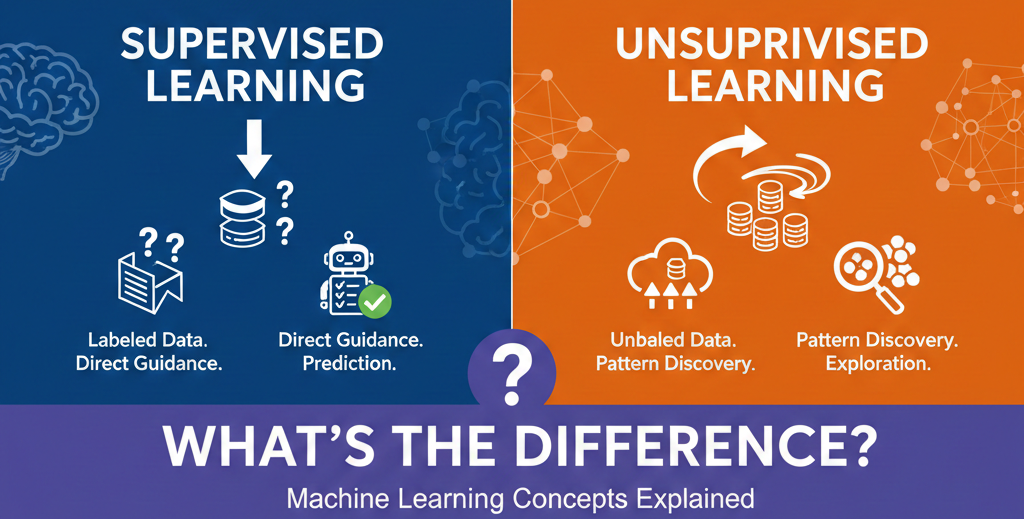
Machine learning is a key part of modern artificial intelligence, enabling systems to learn from data and make decisions without being explicitly programmed. Two of the most common learning approaches are supervised learning and unsupervised learning. While both methods help uncover patterns in data, they differ significantly in how they work, the type of data they use, and the problems they solve. Understanding these differences helps businesses and practitioners choose the right approach for their needs.
What Is Supervised Learning?
Supervised learning is a machine learning approach where models are trained using labeled data. Each data point includes both the input and the correct output. The model learns by comparing its predictions with the known results and adjusting its parameters to reduce errors.
This learning process is similar to teaching with examples. The model is shown many instances of inputs paired with correct answers, allowing it to learn the relationship between them.
Common Use Cases
Supervised learning is widely used in applications where outcomes are known and accuracy is critical. Examples include:
-
Email spam detection
-
Credit risk assessment
-
Medical diagnosis
-
Image and speech recognition
Because the expected output is defined, supervised models are highly effective for prediction and classification tasks.
What Is Unsupervised Learning?
Unsupervised learning works with unlabeled data. The model does not receive predefined outputs. Instead, it explores the data on its own to find hidden patterns, groupings, or relationships.
Rather than being guided by examples, the algorithm identifies similarities and structures within the dataset. This approach is useful when data is abundant but labels are unavailable or expensive to obtain.
Common Use Cases
Unsupervised learning is commonly used for:
-
Customer segmentation
-
Market basket analysis
-
Topic modeling
-
Anomaly detection
It is especially valuable for exploratory analysis and discovering insights that were not previously known.
Key Differences Between Supervised and Unsupervised Learning
1. Data Labeling
Supervised learning requires labeled datasets, meaning each data point includes the correct answer. Unsupervised learning uses unlabeled data and focuses on pattern discovery.
2. Learning Objective
Supervised learning aims to predict outcomes or classify data accurately. Unsupervised learning aims to identify hidden structures or relationships within data.
3. Model Evaluation
Supervised models are evaluated using metrics such as accuracy, precision, and recall because the correct outputs are known. Unsupervised models are harder to evaluate since there is no ground truth, and results are often assessed qualitatively.
4. Complexity and Interpretability
Supervised learning is generally easier to understand and validate because outcomes are clearly defined. Unsupervised learning can be more complex, as the results may require interpretation by data experts.
5. Business Application
Supervised learning supports decision-making, forecasting, and automation. Unsupervised learning supports discovery, insight generation, and data exploration.
Strengths and Limitations of Each Approach
Supervised Learning Strengths
-
High accuracy for well-defined tasks
-
Clear performance measurement
-
Strong reliability in production systems
Supervised Learning Limitations
-
Requires large labeled datasets
-
Labeling can be time-consuming and costly
-
Less flexible for discovering unknown patterns
Unsupervised Learning Strengths
-
Works with raw, unlabeled data
-
Identifies hidden patterns and insights
-
Useful for early-stage data exploration
Unsupervised Learning Limitations
-
Results may be harder to interpret
-
Evaluation lacks clear benchmarks
-
May produce less precise outcomes
When to Use Each Approach
Supervised learning is best when the problem has clear outcomes and labeled data is available. It is ideal for prediction, classification, and automation tasks.
Unsupervised learning is best when the goal is to explore data, identify patterns, or segment information without predefined categories. It is often used as a first step before applying supervised techniques.
In many real-world systems, both methods are combined. For example, unsupervised learning may be used to cluster data, and supervised learning may then classify new data based on those clusters.
Conclusion
Supervised and unsupervised learning serve different purposes in machine learning. Supervised learning focuses on accuracy and prediction using labeled data, while unsupervised learning emphasizes discovery and pattern recognition using unlabeled data. Choosing the right approach depends on the nature of the data, the availability of labels, and the business objective. Understanding these differences allows organizations to build smarter, more effective AI systems.
Frequently Asked Questions (FAQs)
1. What is the main difference between supervised and unsupervised learning?
Supervised learning uses labeled data with known outcomes, while unsupervised learning works with unlabeled data to discover patterns and relationships.
2. Is supervised learning more accurate than unsupervised learning?
Supervised learning often provides higher accuracy for prediction tasks because it is trained using known outcomes.
3. Why is unsupervised learning important?
Unsupervised learning helps uncover hidden insights, groupings, and trends that may not be obvious in large datasets.
4. Can supervised and unsupervised learning be used together?
Yes, many AI systems combine both approaches to improve data understanding and model performance.
5. Which learning method is better for business applications?
It depends on the goal. Supervised learning is better for prediction and automation, while unsupervised learning is useful for exploration and insight discovery.